- Full rooftop AC unit diagnosis, repair, and replacement on site
- Fan motors, gaskets, drainage, shrouds, and electrical connections
- All brands: Dometic, Coleman-Mach, Advent Air, Furrion, and more
- Mobile service across Jensen Beach and Martin County
- Call 772-356-0328 for a free estimate
What Goes Wrong with RV Rooftop AC Units?
The rooftop AC unit is probably the hardest-working component on your RV, at least here in Jensen Beach. It sits on top of your roof completely exposed to the sun, rain, and salt-laden air coming off the coast. It runs for 8 to 10 months out of the year. And unlike your home AC, it doesn't have the luxury of being a full-sized system with redundant parts and easy access for maintenance.
I've been repairing RV rooftop AC units for over 10 years, and the problems I see fall into a handful of common categories. Most of them are preventable with regular maintenance, but let's be honest, most people don't think about their rooftop AC until it stops working.
The good news is that most rooftop AC problems don't require a full unit replacement. A targeted repair is usually enough to get you back to comfortable temperatures. Here's what I see most often and what you should watch for.
Fan Motor Problems
The fan motor is one of the most common failure points on a rooftop AC unit. There are actually two fans in most units: the condenser fan on the outside that blows hot air away from the coils, and the evaporator fan (or blower) on the inside that pushes cold air into your RV.
When the condenser fan fails, the unit can't dissipate heat efficiently. The compressor overheats, the unit stops cooling, and if you keep running it, you'll burn out the compressor too. That turns a $300 fan motor repair into a $1,200 compressor replacement.
The evaporator fan failure is easier to notice because you'll feel the airflow drop inside your RV. Sometimes the fan still spins but at reduced speed, which means the motor bearings are wearing out. Other times it stops completely. In either case, the fix is straightforward if you catch it early.
Have you noticed a rattling or humming noise coming from the roof when your AC kicks on? That's usually a fan motor that's starting to fail. The bearings are getting loose, and the motor is working harder than it should. Getting it replaced now, before it seizes up, saves you money and prevents secondary damage to other components.
Drainage Issues
Every rooftop AC unit produces condensation as it cools the air. In Florida's humidity, that's a significant amount of water. The unit has a drain pan and drain channels designed to route that water off the roof. When those channels clog, the water has nowhere to go.
Clogged drainage is one of the sneakiest problems because you might not realize it's happening until you've got water damage inside your RV. The water backs up in the drain pan, overflows, and seeps through the gasket or the mounting bolts into your ceiling. I've seen water stains, soft spots in the ceiling, and even mold growth that all traced back to a clogged AC drain.
The fix is usually simple: cleaning out the drain channels and pan, checking for algae buildup (very common in Florida's warm humidity), and making sure the drain path is clear. But finding and repairing the water damage it caused? That's a different story. This is exactly why annual maintenance matters so much down here.
Gasket Deterioration
The gasket between your rooftop AC unit and the roof surface is a critical seal. It keeps water out and conditioned air in. Over time, especially under Florida's UV exposure, that gasket dries out, cracks, and loses its ability to seal properly.
A failed gasket lets rainwater leak into your RV around the AC opening. It also lets cooled air escape around the edges, which means your AC has to work harder to maintain temperature. Both problems cost you money, one in water damage repairs and the other in wasted energy.
I recommend inspecting the AC gasket every year and replacing it every 3 to 5 years as a preventive measure. The gasket itself costs about $15 to $40 depending on the unit. Installing it takes about an hour. Compare that to the cost of repairing a water-damaged roof, and you can see why this small maintenance item makes such a big difference.
Does the area around your rooftop AC unit feel soft or spongy when you press on it? That's a warning sign that water has already gotten past the gasket and into the roof substrate. Don't ignore it. Call me at 772-356-0328 and let's take a look before it gets worse.
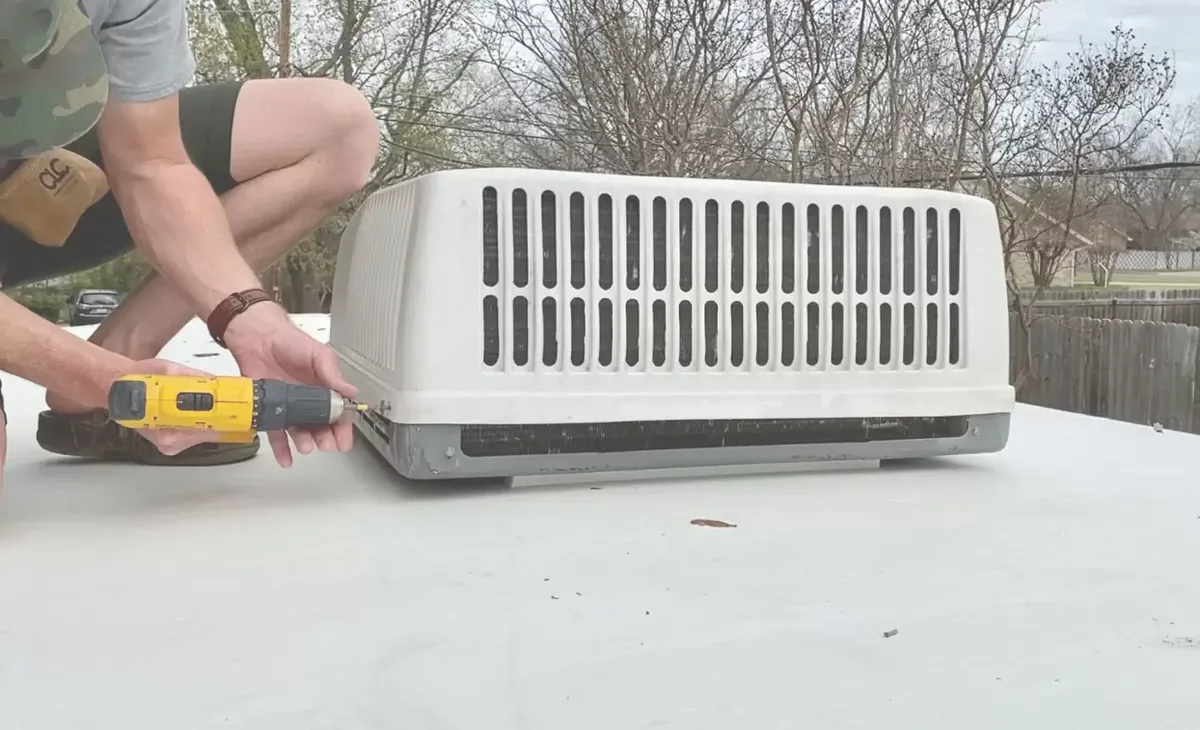
Shroud and Housing Damage
The plastic shroud on top of your AC unit is more than cosmetic. It protects the condenser coils, fan, and electrical connections from direct exposure to the elements. When the shroud cracks, breaks, or blows off (which happens more often than you'd think during storms), the internal components are exposed to rain, debris, and UV damage.
I carry replacement shrouds for the most common Dometic and Coleman-Mach models. For less common units, I can usually source the part within a day or two. In the meantime, if your shroud is damaged, I'd strongly recommend at least covering the unit with a temporary shield to prevent further damage to the internals.
Electrical Connection Problems
The wiring between your rooftop AC unit and your RV's electrical system runs through the roof opening. Over time, vibration from travel, thermal expansion and contraction, and corrosion can loosen connections or damage wires. This can cause the unit to run intermittently, blow fuses, or not start at all.
I check every electrical connection during a service call: the power supply wiring, the thermostat wiring, capacitor connections, and the control board. A loose wire at the terminal block is a common finding, and it's also one of the easiest fixes. But left unaddressed, a loose connection generates heat, and that can melt wiring insulation or damage the control board.
When to Repair vs. Replace the Entire Unit
Here's the question I get asked at almost every rooftop AC service call: should I fix this one or just get a new unit?
My general rule is this: if the unit is under 10 years old and the repair cost is less than half the price of a new unit, repair it. If the unit is older than 12 years and you're looking at a major repair (compressor, control board, or multiple components), replacement usually makes more financial sense.
New rooftop AC units run $800 to $1,500 for the unit plus installation. A repair might be $200 to $600 for most common issues. So the math usually favors repair unless the unit has multiple problems stacking up.
I'll always give you both numbers so you can decide what works best for your budget and your plans for the RV. No pressure either way.
When Should You Call for Rooftop AC Service?
Don't wait until the middle of July when it's 95 degrees outside and you're sweating through your shirt. If you notice any of the following, give me a call sooner rather than later.
The AC isn't cooling as well as it used to. Reduced cooling output is the first sign that something is going wrong, whether it's low refrigerant, dirty coils, or a failing component. Catching it now means a cheaper repair.
You hear unusual noises from the roof. Grinding, rattling, buzzing, or clicking sounds all point to specific problems that are easier (and cheaper) to fix early.
Water is dripping inside your RV near the AC unit. This means either the drain is clogged or the gasket has failed. Either way, the longer you wait, the more water damage you'll have to deal with.
The unit won't turn on or keeps tripping the breaker. This is an electrical issue that needs professional diagnosis. Don't keep resetting the breaker hoping it'll stay on.
Is your rooftop AC acting up? Call 772-356-0328 and let's figure out what's going on. Most calls get same-day or next-day service.