- Full roof sealant replacement on all penetrations, seams, and edges
- Elastomeric roof coatings for UV protection and waterproofing
- Sealant refresh: $300 to $800. Full coating: $1,000 to $2,500
- In Florida, sealant should be inspected annually and replaced every 2 to 3 years
- Call 772-356-0328 for a free roof assessment
Why Sealant Is Your Roof's Most Important Protection
Here's something most RV owners don't think about: the membrane on your roof (whether it's EPDM, TPO, or fiberglass) isn't what fails first. The sealant does. Every seam, every penetration, every edge where the membrane meets something else is sealed with a bead of sealant. And that sealant takes a beating from UV radiation, thermal expansion, and Florida rain.
When sealant cracks, shrinks, or pulls away from the surface, water gets in. It doesn't take much. A crack the width of a hair is enough for water to find its way through during a heavy storm. And once water gets under the membrane, it spreads out along the decking and causes damage you can't see until it's already significant.
I inspect dozens of RV roofs every year in Jensen Beach, and I can tell you that the majority of them have at least some sealant that needs attention. It's the most common roof maintenance item, and it's also the cheapest to address when you catch it early. Replacing cracked sealant costs a fraction of what it costs to repair the water damage that happens when you don't.
Types of RV Roof Sealant
Not all sealants are the same, and using the wrong one is worse than using none at all. Here's what you need to know about the products I use.
Dicor self-leveling lap sealant. This is the standard for horizontal joints on RV roofs. It flows into cracks and seams, self-levels to create a smooth seal, and stays flexible enough to handle thermal expansion. I use it around AC units, vents, antennas, and anywhere the joint is horizontal or nearly so.
Dicor non-sag sealant. For vertical or angled joints where self-leveling sealant would just run off, non-sag holds its shape. I use it on the front and rear cap transitions, along edge trim, and anywhere gravity would pull self-leveling sealant away from where it needs to be.
Eternabond tape. For seam repairs and larger areas, Eternabond is a rubberized tape with aggressive adhesive that creates a permanent waterproof bond. It's used in combination with sealant for belt-and-suspenders protection on critical areas.
Silicone sealant. On fiberglass roofs (not rubber or TPO), silicone sealant is sometimes the right choice. It doesn't bond to EPDM rubber, which is why material matching matters. I always verify your roof type before selecting the sealant product.
What a Full Sealant Replacement Looks Like
A full reseal isn't just squirting new sealant over the old stuff. That's a shortcut that fails within a year. Here's the correct process.
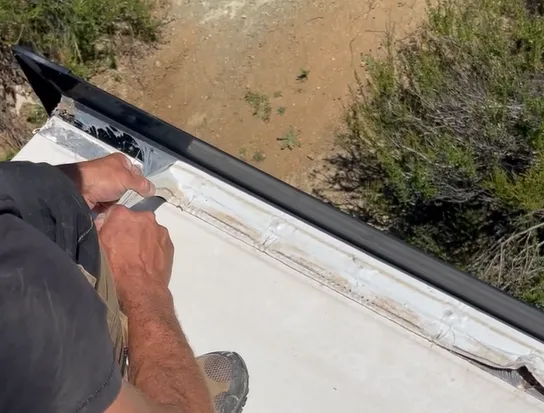
First, I remove all existing sealant from every penetration, seam, and edge on the roof. I scrape it down to the clean membrane or surface, making sure there's no old residue left. New sealant doesn't bond well to old sealant, and any debris trapped underneath creates a channel for water.
Second, I clean and prep each area. Depending on the roof type, this might involve using a specific cleaner or primer to ensure the new sealant bonds properly. For EPDM roofs, I use an EPDM-specific primer on areas that need extra adhesion.
Third, I apply the new sealant in a continuous bead that covers the entire joint with no gaps. Self-leveling sealant gets applied to horizontal surfaces and allowed to flow into the joint. Non-sag sealant gets pressed into vertical joints by hand to ensure full contact.
Fourth, I inspect every single sealed area before I leave. I'm looking for complete coverage, proper adhesion, and no gaps or thin spots. If anything doesn't look right, I fix it on the spot.
The whole process takes 3 to 5 hours for an average-sized RV with typical roof-mounted equipment.
Roof Coatings: When and Why
A roof coating is different from sealant. While sealant protects specific joints and penetrations, a coating covers the entire roof surface with a thick, protective layer. Think of it as a fresh skin for your roof.
Elastomeric coatings are the most common type for RVs. They're rubberized, flexible, and create a waterproof barrier that also reflects UV rays. On a white-coated roof, interior temperatures can drop by 10 to 15 degrees compared to an uncoated dark membrane. That means less work for your AC and lower energy costs.
When does a coating make sense? If your EPDM or TPO membrane is getting old, showing UV oxidation, but isn't torn or structurally damaged, a coating can add 5 to 10 years of life. It's significantly cheaper than a full membrane replacement and can be applied on site in a single day under the right weather conditions.
Is your roof starting to look tired, chalky, or faded? A coating might be exactly what it needs. Call me at 772-356-0328 and I'll take a look to see if your roof is a good candidate.
How Often Should You Reseal Your RV Roof?
In Florida, I recommend an annual roof inspection and sealant replacement every 2 to 3 years. That's more frequent than manufacturers recommend for cooler climates, but Florida's UV intensity and rain volume demand it.
Here's a simple way to check between professional inspections: get on your roof (carefully) and press your thumbnail into the sealant at a few different spots. If it's flexible and springs back, it's still good. If it's hard, cracked, or crumbly, it's time for replacement.
Have you bought a used RV and aren't sure when the sealant was last replaced? Assume it needs doing. Used RV sellers rarely mention roof maintenance, and most buyers don't think to ask. A sealant refresh on a used RV is cheap insurance against expensive water damage.
Common Mistakes I See with Sealant
Over the years, I've fixed a lot of sealant jobs that were done incorrectly. Here are the most common mistakes.
Applying new sealant over old. This never works long-term. The new sealant bonds to the old sealant, not to the roof surface. When the old sealant continues to deteriorate underneath, the whole thing peels up.
Using the wrong product. Silicone on EPDM. Latex caulk on anything. Hardware store "roof sealant" that isn't designed for RV membrane roofing. Wrong products either don't bond, damage the membrane, or fail within months.
Incomplete coverage. Leaving gaps in the sealant bead, even small ones, gives water a path through. Sealant needs to be continuous and cover the entire joint without interruption.
Applying in bad conditions. Sealant needs clean, dry surfaces above 50 degrees to bond properly. Applying it in the rain, on a dirty surface, or in cold weather is a waste of time and material.
When to Call About Sealant and Coating
If you haven't had your roof sealant inspected in over a year, that's reason enough to call. If you can see cracks in the sealant from the ground, it's definitely time. And if you've got water stains inside, the sealant has already failed somewhere and you need repair, not just replacement.
Call 772-356-0328 and let's get your roof protected before Florida's rainy season makes the problem worse.